
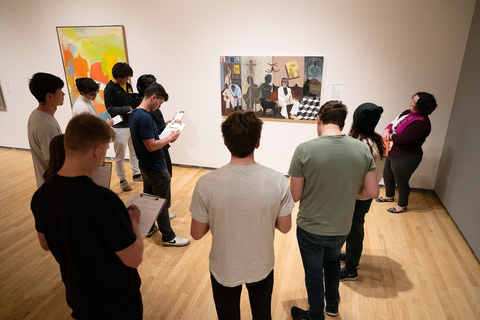
The students walk past busts, African masks, urns, and famous paintings. They quietly follow a curator, turning through a labyrinth of galleries and stop in front of a surreal painting in a corner of the Stanley Museum of Art.
Welcome to Intermediate Macroeconomics.
While it may seem an odd setting for a macro class, it all makes perfect sense to Associate Professor Alexandra Nica, who has long blended economics and art in her own life as a business instructor and concert pianist. When the opportunity arose to meld the two worlds for her students, she jumped at the chance.
“It started when the UI Center for Teaching and the Stanley Museum put out a call to University of Iowa faculty to submit proposals for ArtInfuse, a teaching program designed to help instructors refresh their courses by integrating the arts,” Nica said.
Her idea to bring macroeconomics students to the museum to hone their observational skills was one of five projects ultimately selected from across the university. Other disciplines included audiology, education, studio art, and Swahili.
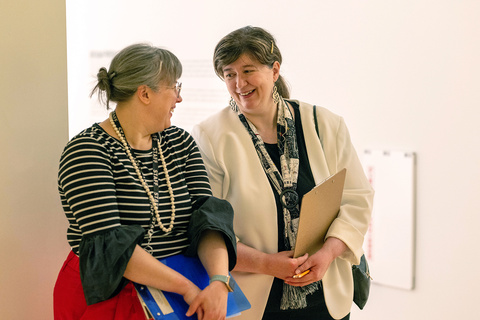
“It was really exciting to have somebody from business wanting to use the Stanley,” said museum curator Kimberly Datchuk. “Many of her 55 students had never been here.”
“We liked Alexandra’s project a lot because she was willing to be creative about identifying a strategy that would improve students’ learning,” said Anna Flaming, director of the Center for Teaching.
More than just a field trip, Nica pursued ArtInfuse because she had noticed students struggling to give concise analysis of macroeconomics graphs. Working in collaboration with the Center for Teaching, the Frank Business Communication Center, and museum curators, Nica created a project where students were coached to look closer.
“I wanted them to learn to slow down and look at the details,” Nica said.
Students were grouped and began by playing “Art Boggle,” where they simply looked at a painting and wrote down whatever words came to mind. It could be as easy as a color, or as complicated as an emotion.
Their next challenge was blind contour drawing, where they put their Iowa-branded pencils to work drawing the lines and shapes they saw without looking at their paper.
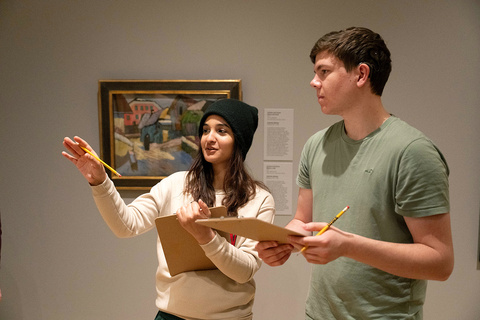
Next, they were asked to participate in “close looking,” where they gazed at a painting for three minutes, talked about it, then studied it for three minutes more. That’s where it got good.
“If you try to look closely, things aren’t always as simple as they seem,” graduate assistant Agnes Harry Mills told one group of students.
Will Sheely, a junior economics major, illustrated the point of the exercise when he said, “The first time I looked, I was trying to memorize details, but the second time around I was trying to see what the message was.”
One of the group leaders, curator Isabel Cazares, told students, “You may notice you gain confidence to describe the piece after close looking.”
Exactly what Nica was after, along with a playful sense of curiosity.
“Part of this is exercise is trying to get them out of the anxious brain and into the curious brain,” she explained. “I want them to always be curious, especially when looking at graphs. They need to be able to move past a basic reading and provide concise interpretations—something they’ll soon be asked to do in their careers. Their boss is not going to want to see two pages, they’ll want two or three sentences explaining what a visual says and importantly, what it actually means.”
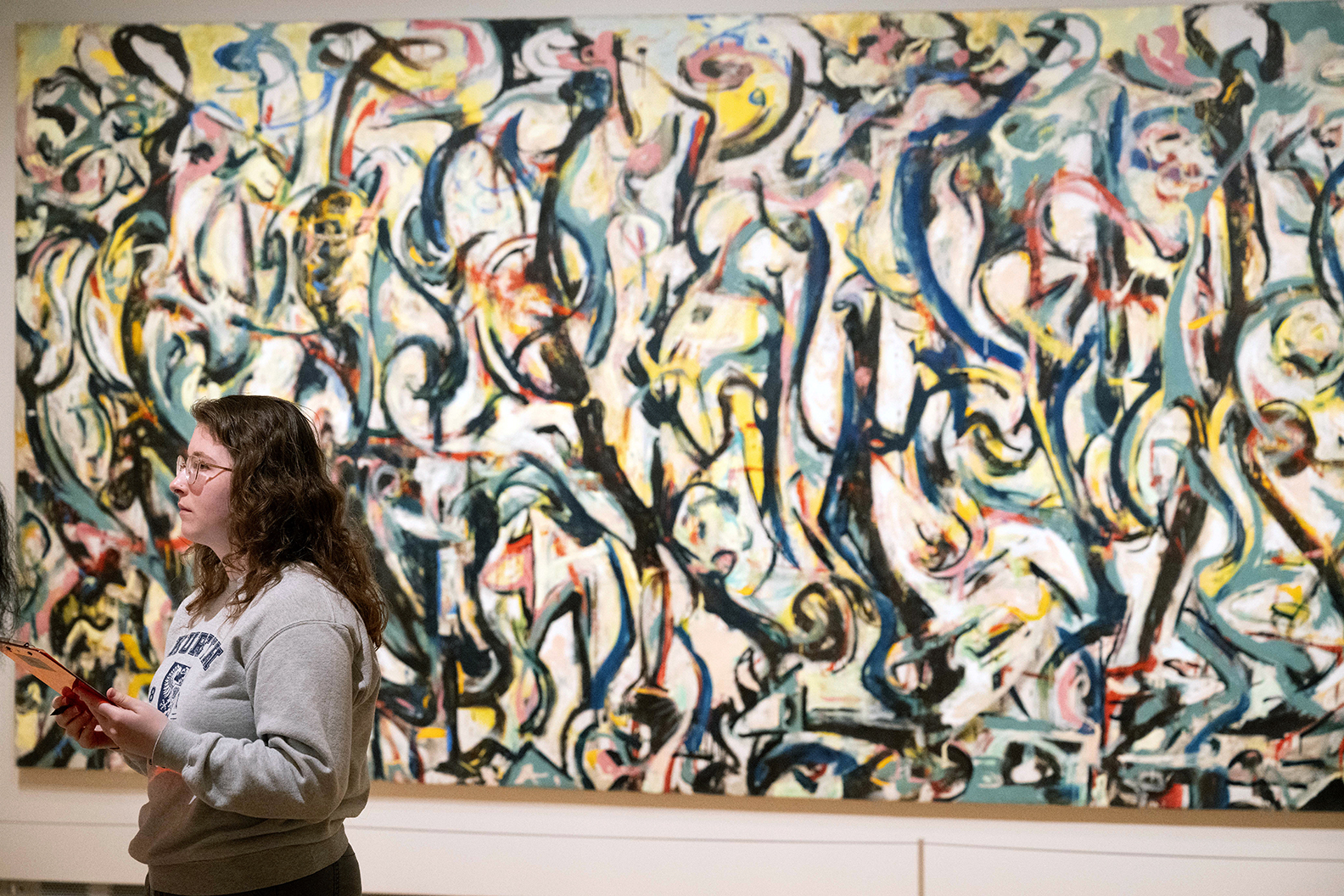
To tie these concepts more clearly to the classroom, the students’ last activity at the museum was to link at least three economics concepts from class to an artwork of their choosing.
One student noted how an African tapestry’s patterns illustrated statistical discrepancy, as well as the convergence to steady state in the Solow growth model. Another student saw links to human capital, industrialization, and importance of trade in an Asante-style mid-20th century sculpture. Jackson Pollock’s Mural sparked ideas regarding the division of labor, creative destruction, and marginal utility for one student, while another thought it illustrated the concepts of scarcity, store of value, and the importance of emotions in the decision-making process, as explored in behavioral economics.
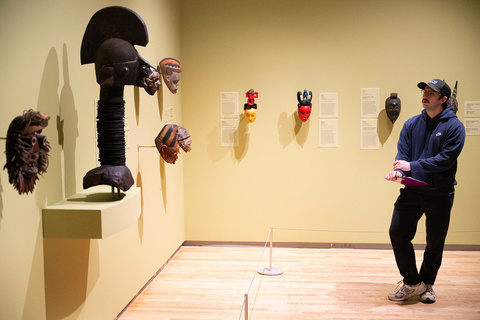
“I wanted to completely take them out of the context of a regular economics classroom because then they see that economics is indeed everywhere,” Nica said.
Sophomore Lily Severson said, “I thought this was a really unique take on an economics class. The trip to the art museum really homes in on how observation skills and analysis play a part in the way we interpret the world. I think it also highlighted that the same data, or same artwork, can be seen from multiple perspectives.”
After the museum experience, Nica reports that students were able to write clearer paragraphs with better in-depth analysis than before, even when the graphs were more complicated.
To wrap up the project, Nica asked for feedback to see if the students felt the trip to the museum helped them with visual observation, problem solving, and communication skills.
Most students reported that the exercises at the museum helped them feel less overwhelmed and more confident when reading graphs.
“After this experience, I started thinking of the story the graph was trying to tell instead of just looking at the data points,” said senior Alina Silwal.
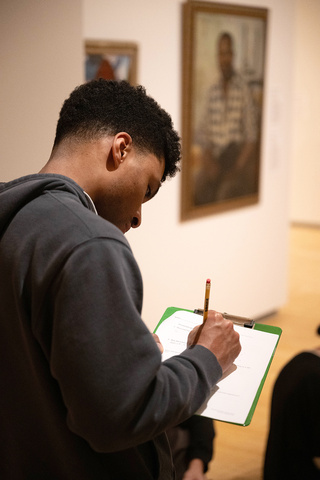
“Given the number of variables, nuances, and other things that can be involved with graphs, sometimes things can get overlooked,” said senior Jake Udovich. “It was a valuable lesson to learn.”
But the students weren’t the only ones gaining insight from this project.
“I learn from them, and they learn from me. It’s all a big learning experience,” Nica reflected.
“At the Center for Teaching, I have noticed that Alexandra is always interested in being better for her students every time she teaches. I really admire that,” director Flaming said.
Would she take students to the Stanley again?
“Definitely, maybe with my 600 Principles of Macro students next…,” Nica said.
When asked how the Stanley would accommodate hundreds of students from a single course, curator Datchuck said, “It’s a good problem to have. I think we can figure it out—it will just take a little creativity.”
DYK? Alexandra Nica won a 2025 President and Provost Award for Teaching Excellence, given to outstanding faculty at the University of Iowa. She has previously been honored at Tippie as one of the most innovative professors.
This article appeared in the Fall 2025 issue of Tippie Magazine.
Photos by Justin Torner.