
Nothing in Professor Patrick Fan’s resume hints that his work could vastly improve cancer patient outcomes.
He’s a business analytics professor, not a doctor or clinician. His wheelhouse is using natural language processing and AI to better understand financial risk assessment and improve search engine optimization.
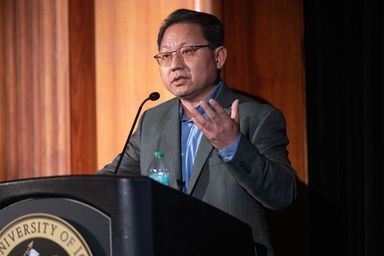
to deliver the prestigious University of Iowa Presidential Lecture about his research (pictured here).
Yet Fan is at the forefront of an exciting revolution in health care—one powered by AI, machine learning, and advanced analytics—in collaboration with University of Iowa Health Care.
Fan uses cutting-edge technology to analyze medical data like notes from a doctor’s visit, patient symptoms, prescriptions, and treatment plans. His models can compare thousands of patients’ data to forecast risks, assist with early diagnoses, and prevent complications during cancer care.
The ability to pull meaningful data from patient records using machine learning and analytics tools has reduced the formerly massive amounts of time and manpower to do so, Fan said. All data used by researchers is HIPAA compliant and de-identified to protect patient confidentiality.
This transformation allows researchers to take a holistic view, connecting dots that were once hidden in isolated files. It also helps boost clinician productivity and reduces doctor burnout.
"It helps doctors focus on what matters most—their patients—instead of getting bogged down
in paperwork,” he said.
Not everything in the fight against cancer is about finding cures and unearthing new drugs, Fan said. Just making patients more comfortable—even those with terminal diagnoses—is a worthwhile effort, another thing made easier with advanced technology.

One way Fan is doing this is by working closely with Stephanie Gilbertson-White, associate professor and director of the Ph.D. program at the College of Nursing.
Their work has already made a difference in patients’ lives through the creation of “person-level” models that allow physicians to predict with more accuracy what types of adverse symptoms patients may face as they progress through their cancer journey, and try to stay a step ahead of them.
Gilbertson-White said one of the strengths of using large patient information datasets is the sheer volume.
"If I had five years and $2 million grant to do a study, I could probably recruit around 500 people,” she said. “Whereas one of the smaller projects I’ve done with Patrick and his team included more than 20,000 patient records. It's orders of magnitude higher."
Using medical datasets is also preferable because all patients who were treated for a particular cancer are analyzed. In contrast, study participants sometimes opt out if they feel too ill to participate, which injects bias because researchers are only collecting data from patients feeling well enough.
"If I want to understand how people are feeling, having those who feel the worst not participate is a huge gap,” Gilbertson-White said.
This matters because severe symptoms often hamper effective treatment of the cancer itself. If patients are struggling with uncontrolled dehydration or fever, they may have to delay treatments like radiation or chemotherapy, which can lead to potentially grave outcomes.
Fan said cross-campus collaboration is not only something the university encourages, it also makes him feel like his work makes a difference.
"Business analytics is about using technology to solve real-world problems,” Fan explained. “As a faculty member at the University of Iowa, I have a responsibility to do research that transforms society and benefits people.”
DYK?
When he’s not finding ways to help cancer patients manage symptoms through machine learning, you might find Fan with his Canon R5 Mark II camera down by the Iowa River, capturing stunning eagle photos.
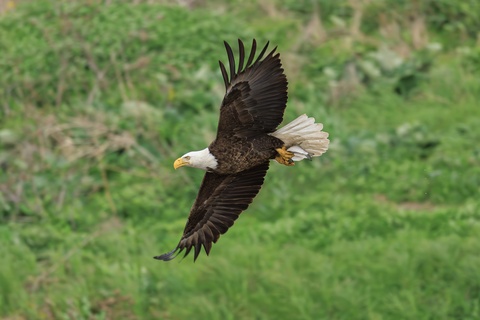
Fan has long loved the majestic birds and is thrilled the University of Iowa is one of the best campuses in the country for eagle spotting. He began photographing them in earnest around two years ago. This eagle shot, taken near the Benton Street Bridge, features a bird he named Henry.
Yes, after that Henry.
"I am holding the title of Henry B. Tippie Excellence Chair, and this seemed like a fun way to honor him for his generosity to the college," Fan said.
See more of Fan’s nature photography at facebook.com/patrickwfan.
This article appeared in the Fall 2025 issue of Tippie Magazine.