
by Tom Snee
Erik Lie’s new book probably won’t win him many friends in the corporate world.
The book, “Catching Cheats: Everyday Forensics to Unmask Business Fraud,” exposes how corporate executives, accountants, stock traders, bankers, and other shady characters accumulate wealth through fraud, deception, and general illegal behavior.
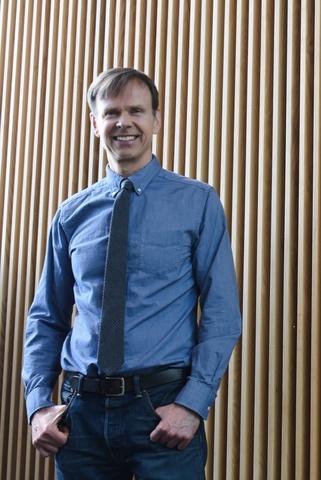
Lie, a professor of finance at the Tippie College of Business, features a rogue’s gallery of crooks and frauds from the last 30 years who stole billions and, in some cases, helped drive the economy into a ditch with their manipulations.
Bernie Madoff, the charming Ponzi schemer who conned thousands of people who should have known better.
Ken Lay, Jeffrey Skilling, and Andy Fastow, who brazenly manipulated accounting practices to drive up Enron’s stock price only to have it collapse into what was at the time the largest corporate fraud in American history.
There’s insider trading from Martha Stewart and dozens of government officials; Elizabeth Holmes, the Theranos founder whose $9 billion company was actually worth nothing because she covered up the fact their product didn’t work; and the colluding stock traders who lined their own pockets by driving up the cost of trades.
The book also shows how whistleblowers, investigators, academics, and journalists can make it all fall apart and send some of the cheats to prison by using cutting edge forensic techniques in accounting and economics.
Lie has a record as a whistleblower himself. Research he conducted in the early 2000s discovered that corporate executives were illegally accounting for the dates on which they exercised stock options in order to increase their value, which he coined “options backdating.” The research was the foundation of a Pulitzer Prize-winning Wall Street Journal investigation, led to numerous federal prosecutions, and earned Lie a spot on the TIME 100 list in 2007.
Lie says it was this corporate backdating work that led to his interest in corporate cheating in general, and how data and forensic economics can help identify it and ferret it out.
“In my own experience, I noticed a lot of other similar instances of academics using data to find patterns of cheating, but many of these stories were never told,” he said.
On top of that, he said they’re just good old fashioned compelling stories about human nature—the folly of the powerful and their comeuppance.
As a finance professor, Lie focuses most of the book on the financial sector, an industry rife with both high-profile scandals and small-time frauds. Like his own experience researching backdating, most of the scandals in the book were uncovered by investigators analyzing huge sets of data and spotting anomalous patterns that couldn’t happen naturally. In his own case, for instance, that pattern was hundreds of corporate executives all receiving stock options on the most fortuitous date possible.
But why do the cheats do it? Most of the people in the book who participate in these schemes are financially well-off high rollers who don’t need to cheat to be set for life. Why risk their reputation and fortune to make more money?
“The vast amounts of money in play might just be too tempting to resist, and the sector seems to draw unethical and greedy people,” Lie said.
On the other end, why do people fall for it—especially people who should know better? Most of Madoff’s victims were well educated high achievers who understood business and finance. How did they get taken by something as simple as a Ponzi scheme?
Lie said in many cases it’s because people committing fraud don’t come across as people committing fraud.
“Most of them are seemingly so nice, so people feel there’s no way they can be cheating,” he said. It’s not until it’s too late that they realize they’ve been had.
Don’t get any ideas, though. Lie said that that more often than not, frauds and cheaters are revealed eventually, especially with evolving forensic techniques and so many talented analysts paying attention.
“Catching Cheats” will be published Oct. 7 by Barrett-Koehler Publishers.
Media contact: Tom Snee, 319-384-0010 (o); 319-541-8434 (c); tom-snee@uiowa.edu