
On December 25, 2024, the Indiana Pacers stood 15–15, good for 8th place in the NBA’s Eastern Conference. Lacking big-name stars, media interest, or a sterling record, they were not among the eight teams the league showcased in its popular, marquee Christmas Day lineup.
Injuries had shuffled the rotation, and a few key players were performing under their historical averages. They looked like a “maybe” playoff team, but nowhere near a championship contender.
Inside the front office, though, Spencer Anderson (BBA09/MBA13/JD13) and his team could see something starting to click. Anderson, the Pacers’ vice president for basketball analytics, says the data was telling a better story than that of a middling .500 club.
The staff’s internal metrics showed improving health trends, sharper lineup combinations, and matchups that favored Indiana more often than the standings suggested. The pieces were there—they just hadn’t fallen into place yet.
By the end of January 2025, Indiana had posted the league’s best record, and they were in the NBA Finals by June.
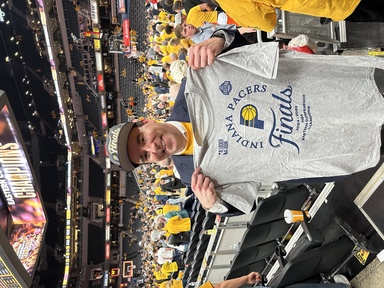
We had injuries and some players not performing up to expectations,” Anderson said. “Once we got everyone back, that momentum carried us.”
Anderson says analytics helped prepare the team for the playoffs, but he is loath to take too much credit for Indiana’s magical run. “A lot of it is coaching, training, and preparation,” he said.
But don’t kid yourself: Anderson is wired to look for any edge that can be exploited.
“I’ve always been a really competitive person,” he said. “I love games, I love sports. I just wasn’t good enough to play at the next level. Analytics became my way to stay in the game.”
He credits the 2003 bestseller "Moneyball" by Michael Lewis, which chronicles how the Oakland A’s general manager Billy Beane used data and statistical modeling to turn baseball on its ear, for his decision to pursue a sports analytics career.
"Moneyball" was still in its early days, but it really opened people’s eyes to how data could be applied to sports,” he said. “I’d say basketball was three to five years behind baseball in terms of investment and application of analytics, but we’ve been catching up fast.”
A modern analytics team must support both coaching decisions as well as front-office strategy. In addition to game plans and scouting models, the team must also evaluate draft picks, trades, and the evolving nature of the game.
Our job is to make the coaches’ lives easier,” Anderson said. “We do that by automating reports, digging out insights, and translating massive datasets into something they can actually use.”
There is an alchemy to blending that data with the very human element of coaching and playing, Anderson stresses. Sometimes that means suggesting the Pacers increase variance when they’re behind—more threes, earlier fouling—or tapping the brakes when they’re ahead. Other times it’s using player-tracking data to understand how someone like Tyrese Haliburton creates space in the pick-and-roll.
“Everything is contextual,” Anderson said. “Players have to execute. Coaches have to teach. We’re just one part of the equation.”
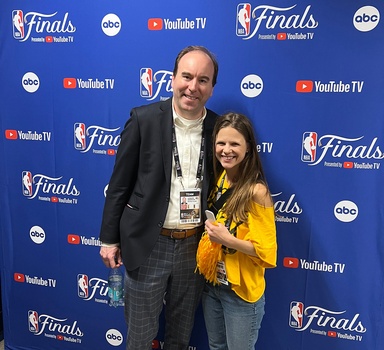
Applying those equations consistently through the end of the season helped the Pacers make their surprise run to the Finals. Becoming a contender wasn’t based on a single breakthrough insight but rather a season full of tiny, unglamorous adjustments—lineup tweaks, injury monitoring, and player-usage rates.
The approach mirrors the way he built his own career: Curiosity about numbers and competition led him toward a job he once didn’t even know existed. Now he’s helping shape what the next decade of basketball analytics will look like and encouraging the next generation of sports-obsessed number crunchers to chase their own dreams.
Figure out what it is about sports that really drives you,” he said. “Know what sets you apart, build the skills, andwhen you get your shot, show people what a Hawkeye work ethic really looks like.”
DYK?
Hawkeye fingerprints are all over Indiana’s pro hoops success. Tippie alum and former Young Alumni Board member Spencer Anderson leads the Pacers’ analytics team, fellow alum Caitlin Clark (BBA24) is lighting up the WNBA for the Fever (part of the Pacers’ ownership group), and Pacers’ general manager Chad Buchanan (MA97) earned his master’s degree at Iowa.
This article appeared in the Spring 2026 edition of Tippie Magazine.