
The struggle with financial literacy is real for many Americans.
That point hit home during Stanford Professor Ed deHaan’s recent Sullivan Scholar lecture at Tippie, when he revealed that fewer than 30% of Americans can correctly answer three of the most basic personal finance questions about interest, inflation, and diversification.
Poor financial literacy isn’t just an academic issue—it carries real consequences. A lack of understanding helped fuel the subprime mortgage crisis in 2007 that triggered the Great Recession.
Today, millions continue to rely on payday advances, high-interest credit cards, and unfixed mortgages without fully grasping the risks. Bad actors thrive in the gap between what people know and what they don’t.
Tippie students are outliers in society, with a firm grasp on financial basics thanks to their studies. Increasingly, some are asking: If we understand this stuff, why aren’t we helping those who don’t?
Two student-driven efforts—Moneythink and FLIP (Financial Literacy Innovation Program)—offer different approaches to the same problem. Together, they reflect a belief that improving financial literacy for everyone is a necessary public good.
Solution #1
MONEYTHINK
For Tippie senior Kyeon Westbrook, the path to community service started with a friend’s nudge during his sophomore year to join Moneythink, a student-run organization that teaches financial basics to high schoolers. He joined for the public-speaking experience but discovered a passion for educating. He is now co-president of the student organization.

"We go into the four big high schools around Iowa City,” Westbrook said. “It makes you realize the community is so much bigger and that these students need this information now, before they graduate.”
Westbrook says most classes are small—eight to ten students—and engagement varies. But there’s always one student who lights up, asks questions, and connects the dots.
"Those moments make it worth it," he said.
Cars are an easy entry point. Students know what interest is, but not how stretching payments over years inflates the real cost. Westbrook tells them about the $1,500 “beater” he bought at 16 and the friend who financed a $13,000 car, totaled it, and had to keep making payments.
"Half of a good lesson is storytelling,” he said. “If they hear it from someone who’s just a few years older, it sticks.”
Moneythink also reaches students in iJAG (Iowa Jobs for America’s Graduates), many from lower-income families with firsthand experience of payday loans or check-cashing services. Lessons stay grounded in real life: why to avoid "zero-down" offers, how credit scores shape futures, and why saving even $10 a week matters.
"These concepts seem obvious to us now, but not if you’ve never been exposed to them,” he said.
Increasingly, the group addresses modern money traps facing teenagers—from sports betting apps to installment payments on fast food.
"You've got to meet them where they are,” Westbrook said. “If you don’t understand who really benefits in those systems, it’s easy to get burned.”
Solution #2
FLIP
If Moneythink is about peer mentorship, FLIP is about scale.
Seniors Landon Stoll and Patrick Igo started FLIP after realizing how many fellow students, friends, and even family members felt uncomfortable managing money.
“Even my girlfriend didn’t feel confident with things like investing,” Stoll said. “I realized how much I took for granted because my parents taught me.”
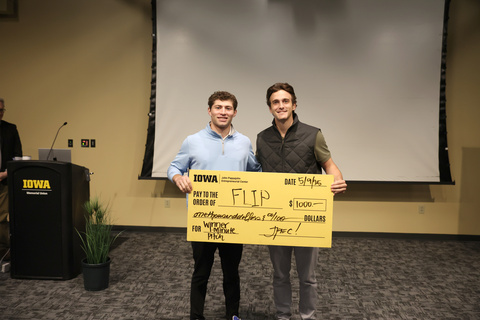
FLIP is a multimedia curriculum that blends game-style learning, analytics, and mentorship to teach financial fundamentals—especially compound returns, a concept Henry B. Tippie (BSC49) often championed.
"It's a two-pronged model Igo explained. “There’s the online platform—games, modules, an AI-driven literacy index. But the real value is mentorship at scale, connecting business professionals to students, semester after semester.”
The model addresses a longstanding delivery problem. There are plenty of financial literacy curricula, but not enough engagement—especially for teenagers who’ve never seen someone model good financial decisions at home.
"Students decide whether they’re ‘learners’ or ‘non-learners’ extremely early,” Igo said. “If we reach them before high school—or even at that inflection point—we can change their trajectory.”
Stoll and Igo already won a John Pappajohn Entrepreneurial Center end-of-semester pitch competition and attracted interest from chambers of commerce, business leaders, and school administrators in Dubuque and Des Moines, IA. Their time is limited as they begin full-time jobs, but the long-term vision remains: a statewide model that could become a national benchmark for financial literacy access.
"In a perfect world, this isn’t a profit-driven company,” Stoll said. “It’s a pipeline—getting real professionals in front of teens who need guidance as they’re starting their lives.”
This article appeared in the Spring 2026 edition of Tippie Magazine.