
Six minutes.
That’s how long students Emily Davis and Drew Matlock had to persuade a room full of London insurance executives that they had a viable solution to one of the industry’s most urgent challenges: artificial intelligence risk.
The clock and pressure were real. And the client—Willis Towers Watson (WTW), one of the world’s largest insurance brokers—was serious about hearing actionable solutions.
“In a six-minute presentation, you can’t go deep into the weeds,” Davis said. “You have to be clear about what matters.”
The real-world opportunity for the two Iowa seniors came about thanks to Jim Lewis’ Insurtech Innovation course. Lewis is the executive director of the Vaughan Institute for Risk Management and Insurance at Tippie and was responsible for planning and guiding the two-week study abroad experience.
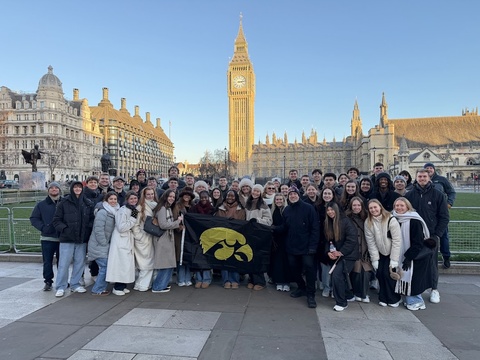
The presentations were at Lloyd’s of London—the centuries-old marketplace that helped formalize modern insurance—as well as Lloyd’s Lab, its innovation arm that connects startups with global carriers and brokers. Lewis framed the experience as a journey “from the birth to the future of insurance.” Prior to the student presentation, WTW leaders had delivered a “reverse pitch,” outlining real pain points facing their organization including the increasingly complicated question of how to insure AI systems that don’t behave as expected.
AI is already embedded in many business operations. But as WTW leaders explained, it’s created a gray area in insurance coverage. Traditional cyber policies cover clear failures—hacks, outages, system breakdowns—but AI presents a different challenge.
Matlock said AI could start hallucinating orders or misrouting transactions and technically still be “working” but force the business to shut down temporarily. Shutdowns mean lost revenue and unhappy customers, even if the system never technically “failed.”
“That’s where specialized AI coverage comes in,” Matlock said.
These gray areas are not implausible hypotheticals. They are questions that many companies adopting AI systems are now facing, and why WTW asked for advice.
The Tippie students’ recommendation for traditional insurance companies like WTW centered on identifying and partnering with emerging insurtech companies who have more specialized knowledge of AI risk.
For Matlock, the experience gave him a confidence boost.
“They wanted to hear from us. It was a genuine exchange of ideas,” he said.
Adrian Willmott, head of risk advisory, industry and sales for WTW, said the students demonstrated a sophisticated understanding of emerging risk and will be well-equipped to help the industry tackle these evolving problems when they enter the workforce.
“The moment they engage with real-world risk challenges—whether that’s cyber pricing, climate risk, or the complexities of algorithmic underwriting—they stop learning about the industry and actually start working in it,” Willmott said.
Insurance sits at the center of economic resilience, but it faces both a talent shortage and rapid technological disruption, according to Lewis.
“Soon, AI-related risks will be increasingly insurable, and we need people in the industry who understand both risk and innovation,” he said. “If our graduates can strategically deploy AI—understanding how to evaluate it, implement it, and de-risk it—they’ll become future leaders.”
This article appeared in the 2026 issue of Exchange magazine.