

University of Iowa finance professor Erik Lie keeps an old paper stock certificate on the wall in his office. It’s framed with a plaque stating the company’s four core values: “Respect, Integrity, Communication, Excellence.”
The company? … Enron.
Lie’s students rarely notice the relic, which offers “best wishes” from CEO Ken Lay who died of a heart attack shortly after his conviction.
Enron was ranked as one of America’s largest companies until it became one of America’s biggest bankruptcies in 2001, collapsing under the weight of its Byzantine accounting tricks and wiping out the life savings of thousands of employees and retirees.
Professor Lie’s statistical sleuthing shows how market data can detect corporate fraud. His leap to finance industry fame came about five years after Enron when his forensic work helped expose another historic scam: A widespread stock-option backdating scandal.

His research led to the congressional hearings, regulatory investigations, shareholder lawsuits, and the ousting of more than 70 corporate executives.
It revealed that scores of America’s best and brightest had found a way to play the winning lottery numbers before the balls even dropped. For a time, even Apple’s over-idolized Steve Jobs was ensnared.
Lie shared his research with The Wall Street Journal, leading to series of hard-hitting stories, including “The Perfect Payday.” In 2007, it resulted in the newspaper’s only Pulitzer Prize for Public Service, journalism’s most-coveted award, and TIME magazine enshrined Lie on its list of 100 most influential people in the world.
I barely remember writing about all this corporate chicanery, but this was my take at the time:
“It’s hard to imagine that it’s 2006, Enron’s top executives have been convicted and yet we are still uncovering the ways that corporate executives have cheated investors.”
Boy, was I naive. I never imagined living all my days in the Golden Age of Grift. I thought somebody would clean up this mess. But here we are. Lie can still help. He has published a new book: “Catching Cheats: Everyday Forensics To Unmask Business Fraud.”
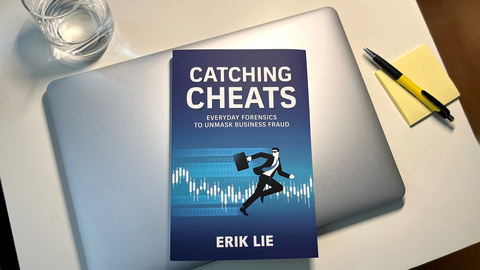
In it, he showcases a slew of research and techniques that can shine bright lights
into dark orders.
“Systemic fraud inevitably leaves behind a trail of data crumbs that attentive and skilled individuals can recognize,” Lie writes.
(The name, by the way, is pronounced “Lee.” He’s Norwegian, OK? And it’s Erik with a K. Sorry, I just happen to enjoy dropping ironic surnames, like Eric (with a C) Conn, who pulled off the largest Social Security con in U.S. history.)
Lie’s book explores the ways large data sets can reveal patterns—like when companies magically outperform their industry benchmarks for quarters on end, or when brokerages surreptitiously shave fractions of pennies from thousands of transactions and steal millions.
Fun fact: Did you know that the number four rarely appears in the first decimal of earnings-per-share figures released by many companies? Better to puff it up to at least five. That way you can round higher. What CEOs want to announce 32 cents a share when they can announce 33?
Almost nobody is counting fractions of pennies and CEOs have to keep Wall Street analysts happy. Right? But Lie cites research that companies massaging their fours often end up making earnings restatements and facing regulatory investigations and lawsuits.

This is the magic of numbers.
This is why the world needs more forensic finance sleuths like Dr. Lie, who earned his Ph.D. in finance from Purdue University and began teaching at the Tippie College of Business in 2004.
Lie’s book offers a tour through many of the fabulous frauds that I have covered myself over the years and memorialized in my Substack, “Business Blunders Hall of Shame.”
His cast of characters includes Ponzi schemer Bernie Madoff, as well as hedge fund billionaire Raj Rajaratnam, who was convicted in a massive insider trading scheme, and even dear old Martha Stewart. Bless her heart.
What I’ve learned over the years is that few people want to believe that our business world is just this crooked. Not until it’s very painstakingly exposed. Not until they wake up to discover that they are the victims.
Investors are optimists. And finance professionals, while good with numbers, can be naive about human nature.
In 2005, the first thing Lie received after submitting his stock-option research to the Journal of Finance was a harsh rejection letter:
“Clearly, executives would be reluctant to go to jail for timing their stock option grants … The idea that most directors in the United States deliberately violate their firm’s charter and possibly face class action suits and … criminal investigations in order to backdate options makes little economic sense.”
Oh, does it now?
Everyone at this esteemed publication deserves a signed copy of Lie’s new book.
Al Lewis has written for The Wall Street Journal, Dow Jones, CNBC, Houston Chronicle, The Denver Post, and Rocky Mountain News.
READ MORE OF LEWIS’ ANALYSIS AT
substack.com/@businessblunders
Tippie Webinar
Hear from Erik Lie himself on how fraudsters operate, why their schemes persist, and the surprising role that data, researchers, and even ordinary observers can play in exposing deception.

BOOK EXCERPT
SALAMI SLICING:
COLLUSION IN THE STOCK MARKET
And the parrot would say, with great rapidity, “Pieces of eight!
Pieces of eight! Pieces of eight!” till you wondered that it was not out of breath, or till John threw his handkerchief over the cage.
—Robert Louis Stevenson,
“Treasure Island”
Interest calculations and paychecks are often rounded down to the nearest cent. In the penny shaving scheme, also known as salami slicing, a thieving computer programmer imperceptibly diverts the fractions of cents to a personal account. Over thousands or millions of transactions, these small slices add up to substantial sums. You might remember the scheme from movies such as “Superman III” and “Office Space.”
A few decades ago, a large group of stock dealers colluded to create their own salami slicing scheme by diverting chunks of stock transaction values to themselves. But at 12.5 cents for each share in a stock transaction, the slices were huge. The bold ploy persisted for years, making it one of the most profitable collusions in history. The heroes in this chapter are two finance scholars who stumbled upon transactions data with missing slices. The discovery left them completely baffled, and some peers refused to believe such a brazen scheme could exist. This led to intense disagreements and the only WrestleMania match in academia. But before we get there, you need a quick background into trading costs…
Read more in "Catching Cheats: Everyday Forensics to Unmask Business Fraud" by Erik Lie. Available wherever books are sold. Excerpt reprinted by permission of Berrett-Koehler Publishers.
Illustrations by Philipp Beck.
This article appeared in the 2026 issue of Exchange magazine.