
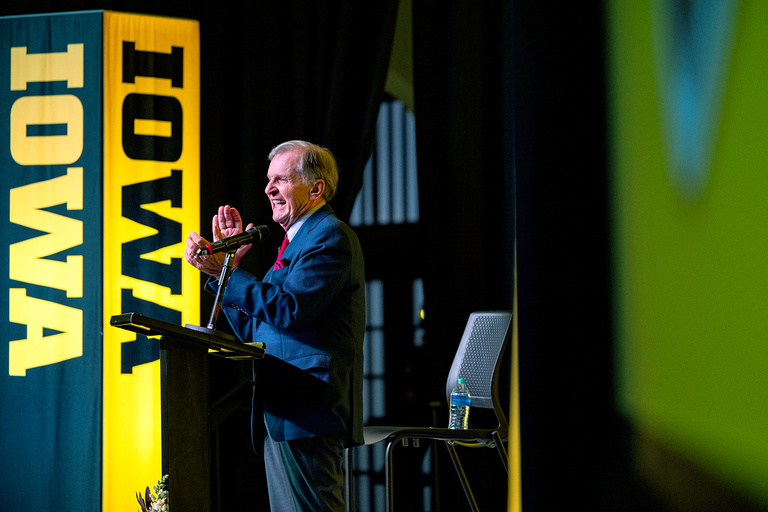
Jerre Stead is a proud business alum and a 10-time public CEO. His latest endeavor is Stead Impact Ventures, where he and his team invest in companies with goals as lofty as conquering ALS and Alzheimer’s.
“Impact is definitely our cornerstone,” he said. “Yes, we want to be profitable and successful, but we also want to make the world a better place. That’s what we should all do.”
You don’t get to where he is by accident. In his interview with Tippie Magazine reflecting on his 47-year career, it's clear he is sharp, confident, kind, and not content with the status quo. He to to where he is by doing things differently.
Whether you’re a CEO, just starting your career, or anywhere in between, we can all learn from Jerre.
Decision making under uncertainty
When you don’t have enough data, what frameworks or instincts do you rely on?

When I don’t have enough data, I dig for more because I’ve learned over many, many years of decision making, it’s better to take a little extra time to gather more facts than it is to jump to a conclusion. Facts are our friends. My instincts have always been, if I know two out of three things I need to know, I’ll be okay. I can return to the missing point later.
Building & evaluating executive teams
What qualities are nonnegotiable in your leadership team?
- Every person must work with open, honest, candid, and caring communication.
- Operate with 100% trust in your people. The first day I’d show up in a corporation, I’d tell them this. And of course, every place I went they asked, “What do you mean trust everybody? You must be crazy! How can you do that? Won’t people do things that you don’t like?” My answer was, “Of course, but if you operate with the assumption that you CAN trust them, you won’t stop people from being innovative.”
- Treat every person with equal dignity and respect. Whenever I have a team in place, I spend all my time and energy helping them be successful—because that’s what works. When you inevitably run into an issue, I’ve always operated with the mantra, “Coach, coach, change.” Coach hard. Do everything you can to help. Do that again. Then, on the third time, let’s find something else they can do, and do better.
Leadership during moments of crisis
How do you maintain trust and clarity when the organization is under pressure?
Expect that a crisis will happen. Stay cool and work together as a team. As the leader, clearly define how you want the crisis to end. What does success look like? Work backwards from there. Assign goals for people to reach the conclusion you want. Remind the team that it’s a part of the life we live and the job we’ve got. Deprioritize other projects that you can come back to, and, because crises evolve, stay with it until it’s done.
I can still remember when I was CEO of Square D and we had a hostile takeover come out of left field. I broke my board into three groups and told them what each would handle. It took about four months and 14 in-person meetings, but it worked out. I had taken over when it was $35 a share, took it up to $80, split it back to $40, and the hostile takeover ended up paying $88 a share, so that was done and done well, but it was because I had the support and trust of the board.
Preparing for leadership
What advice do you have for alumni aiming for a CEO position?
Get on boards early. It makes such a difference because you learn a lot on that side of the table. Before I became a public CEO, I’d already been on three or four.
When I was in my 40s, I was asked to join Ameritech’s board. I went to the first board meeting, and I was the only one under 60, for sure—an instant problem for me. They were looking at me like, “Who is this?” At that meeting, the CFO asked for a motion of approval for a $2.1 billion capital plan for 1989. Someone motioned, they asked for a second, and said, “Any questions?” I spoke up and said, “Yes, I’d like to see what we are going to spend $2 billion on. My company in total doesn’t have $2 billion in revenue. I think it’s important that we learn that together.” Two other board members at the break said, “I’ve always wanted to ask but was afraid to.” I’ll never forget it. It was a great lesson.

Board relationships & governance
What should first-time CEOs understand about managing board dynamics?
Great question, because managing board dynamics is the single most important thing, and something many don’t know coming in as CEO.
- Always try to have a non-executive chair because there are times that you need to speak as CEO, and you can’t if you’re also the chair. Public boards are responsible to shareholders, but as CEO, you’re equally responsible to your customers, your colleagues, and to your vendors.
- Don’t assume that everyone who walks into your board meeting is having a good day. If you get somebody pushing back or making unpleasant remarks, just remember the odds are pretty good that they might have something going on. That stuff happens. That’s real world. That’s people. Sometimes you just have to call “time out” and take a break to reset. It’s part of treating every person with equal dignity and respect.
- You have to have chemistry with the board. If you don’t have it, you’ve got to figure it out. What do we need to do differently? What’s going on? How can I help? Eventually, some people might have to move off the board if they’re not doing the job you need them to do.
- You do not need unanimous agreement, and don’t ever try to get it. It’s okay to have very diverse opinions where majority rules. It’s a weak spot with a lot of board leadership. If you want to get consensus, you’ll end up at the lowest point, and we should never do that. Don’t build your board, and don’t build your mind as a CEO with that goal. “Unanimous” is a word I’ve never used.
- A group of 18 is not a board, it’s a choir. Eleven is a great board.

Personal discipline & work ethic
What habits or routines have been essential to sustaining performance over decades?
I get up at 3 or 3:30 a.m. every day, always have. I only need about five hours of sleep, but that’s not a good program for everybody.
HERE’S WHAT’S IMPORTANT:
- Physical condition is critical. To be the kind of leader you want to be, you’ve got to stay in great shape. First, you need to be a role model. Second, being a CEO is a six-minute-mile marathon that never ends. You’ve got to pace yourself. And you’ve got to be in darn good shape to be running six-minute miles.
- You’ve got to have laughter. It’s an instant vacation. Work is play with a purpose. You’ve got to have that kind of culture and mindset because otherwise you’re going to grind yourself down to the point that you’re just not doing what you’re capable of.
- Mistakes are okay. The single hardest thing, as CEO, is recognizing that you’re going to do your best, but you’re going to make mistakes. And when you do, it’s okay. More importantly, how quickly can you fix it? If you never want to make a mistake, you’ll never make a decision. As CEO, operate with a sense of urgency, make the decision, and be very open to the idea that this one may not work. You’ll be so much more successful.
For my team, I lead with the three Ps—power, protection, permission. I give everybody the power to make the decision, permission to make a mistake, and protection when they make that mistake to fix it and move on. I’ve changed corporations from mediocre to great, just sticking to that.
Culture as a competitive advantage
How did you shape company culture across different organizations?
The culture I built into every company I led was based on my values: Treat every person with equal dignity and respect; Operate with 100% trust; If I had a dollar left, I’d spend it on training and development for my people; Facts are our friends; And have an intense intellectual curiosity about customers. You build that into the culture, you change the game entirely.

When I became the CEO of Square D, I burned the two 400-page policy books in the parking lot to prove a point—because they were handcuffs. We started over. I asked the leadership team, “How do we build policies, procedures, and processes that help our people do their jobs?” The new book was only about 100 pages. It was an 85-year-old company run by engineers, so it was interesting, but we changed the culture.
Strategy that actually works
Strategic success requires strong execution. When you’re setting strategy, what do you do to ensure it’s executable—not just compelling on paper?
I’ve seen so many strategy books over the years that you could read for five minutes and know odds of execution were zero. With every strategy, I ask, “Does it fit the vision and mission we’ve laid out for the organization?” If it does, great, then we move on to measurements.
If you can’t measure a strategy, you don’t have a strategy. I’ve always had a rule of three measures. That is enough to keep your head full. Identify three objectives and measures and then report on them regularly—upside down and backwards.
I used to set up teams and ask them to beat my strategies. I did this at my companies, but also in Iowa’s MBA program with [Emeritus Dean] Gary Fethke. It was a great teaching tool.
The other thing I think a lot about now is how AI is changing the way we approach strategy. It’s so fun. You can play quicker strategy games than ever. I wish I was 53 instead of 83, because in the next 20 years it’s going to get even better.

Legacy, mentorship, & developing others
What’s the most important lesson you’d like to pass on to future leaders?
Every morning for the last 50 years, I start my day by asking, “How do I help great people do great things?”
What makes it so fun, if you really believe it like I do, is that if you surround yourself with great people and dedicate yourself to helping them do great things, they will. That’s the legacy I want to leave. The real measure of success is after you leave a company.

Did you create an environment, strategy, and organization that keeps getting better? That’s the real ultimate objective.
This article appeared in the Fall 2026 issue of Tippie Magazine.