
In the last year, Tippie students have had several notable successes in case competitions, placing in challenges from coast to coast.
Wins included the National Fiscal Challenge in Washington, D.C., where students crafted a proposal to balance the federal budget in 30 years; the Iowa CFA Society Research Challenge, where finance students showcased their investment analysis and portfolio recommendations; and the ENGCOMM International Championship in Montreal, where a University of Iowa team of business and engineering students rallied from last place to capture the title.
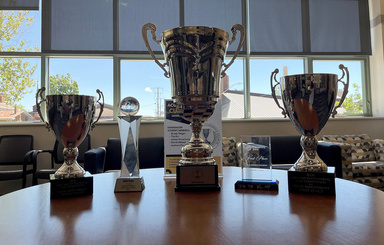
Student teams also advanced to the Fed Challenge semifinals for the first time in more than a decade, earned third place in the prestigious CQA Investment Challenge, and posted strong finishes in other competitions across the country.
Along the way, Tippie also hosted competitors in Iowa City for the inaugural National Impact Case Competition and the inaugural RISC Summit and Innovation Challenge. The college also partnered with corporate sponsors on the inaugural Von Maur Challenge and a 48-hour Uline case competition that asked Tippie students to solve a real business problem.
What’s a case competition?
Case competitions are experiential learning opportunities that happen outside the classroom. Students are handed real-world business problems—usually on location—and given as little as six hours to develop and present solutions. These are often sponsored by companies that provide real data for students to work with and are problems the companies truly want to solve.
Competitions force students to work through disagreements, dead ends, and self-doubt while the clock is ticking. They learn how to defend an idea, accept criticism, and keep moving when things don’t go according to plan. By the end, many discover they’re capable of far more than they thought.
Why have Tippie students performed so well this year?
Two reasons stand out: teamwork and communication.
Patrick Rossmann, associate director for experiential learning at Tippie, said, “Recognition of what everyone brings to the table and appreciating those differences is critical. It’s rewarding to watch students evolve from virtual strangers into high performing teams.”
Senior finance major and ENGCOMM participant Tyree Gardner said, “You learn you don’t have to be in charge of everything. Just be the best at your role.”
Alexandra Nica, professor of instruction and faculty coach for the winning Fiscal Challenge team, said communication training is embedded throughout the preparation process.
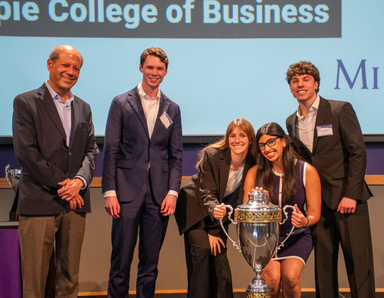
“Our students consistently stand out because of how polished their presentations are, how professional their PowerPoints look, how smoothly they transition between speakers, and how effectively they communicate as a team,” Nica said.
“At the end of the day, the solution matters,” economics student Torin Brown said. “But what matters even more is your ability to explain it.”
The point
After spending hours solving complex problems and presenting to judges from industry, government, and
academia, many students say ordinary class presentations and job interviews suddenly feel much less intimidating.
As Rossmann puts it, “Winning is nice, but the process is invaluable.”
This article appeared in the Fall 2026 issue of Tippie Magazine.