Discover what to consider when choosing the right MBA program —align your ambitions, drive innovation, and shape your future with confidence.
TL;DR
- The right MBA should close the gap between where you are now and where you want your career to go. Look beyond rankings and compare programs based on the skills you'll build, how you'll apply them, the strength of the network, flexibility, cost, and career outcomes.
- Most importantly, choose a program that develops both future-focused capabilities such as AI and data fluency — and durable skills like strategic thinking, communication, and leadership.
What should I consider when choosing the right MBA program for me? IYKYK.
It may not be what you think.
The best MBA program for you isn’t necessarily the one with the highest ranking, the most specializations, or the curriculum that looks most like your current job. It’s the program that builds on what you know and develops what you’ll need.
So, when considering how to choose an MBA program, start somewhere that may feel backward: Evaluate yourself before you evaluate schools.
Ask what could keep you from landing the role you want in three to five years. If you’re an engineer hoping to become an operations director, you may need stronger finance, strategy, and people-management skills. If you’re a financial analyst aiming for a leadership role, you might need more experience influencing teams and making decisions beyond the numbers. Or, if you’re a marketing manager eyeing a broader strategy role, building your analytics and financial fluency could help you make and defend bigger business decisions.
Now turn those gaps into criteria. The skills you’re missing should help determine which programs make your shortlist.
Choose an MBA for where business is going
The skills that got you here may not be the ones that get you there. The Graduate Management Council’s (GMAC) 2026 Corporate Recruiters Survey1 found that data analysis and interpretation, AI-tool skills, and technology/IT skills made some of the biggest gains in importance to employers over the previous year.
But the fundamentals aren’t going anywhere: Communication, problem-solving, and adaptability remain the three skills employers value most in graduate management talent. Looking ahead, employers expect AI-tool skills and strategic thinking to become especially important over the next five years.
Most important skills for current GME graduates, 2025 and 2026
| Skill | 2025 | 2026 | Change |
|---|---|---|---|
| Communication skills | 51% | 64% | +13 pts |
| Problem-solving | 54% | 62% | +8 pts |
| Adaptability | 46% | 60% | +14 pts |
| Data analysis & interpretation | 42% | 59% | +17 pts |
| Technology/IT skills | 40% | 55% | +15 pts |
| Skills in using AI tools | 31% | 50% | +19 pts |
Source: 2026 Corporate Recruiter’s Survey

Benefits of an MBA degree to a company
- Which MBA field has highest salary?
- What careers can you pursue with an MBA?
- How much does an MBA increase your salary?
- Can an MBA help if I’m looking to switch careers entirely?
- What should I consider when choosing the right MBA program for me?
Don’t let the format make the decision for you, either. Employers increasingly view online and in-person graduate business programs equally. Instead of assuming one format carries more weight, look at what the experience actually includes: live interaction, faculty access, collaboration, networking, and opportunities to apply what you learn.
That combination of technical and human skills matters. Natalie Schreffler, assistant director of Graduate Career Services at Tippie, says a strong MBA program gives students opportunities to practice “executive presentations, persuasive writing, difficult conversations, and storytelling with data.”
Problem-solving can also be developed through consulting projects, case competitions, team projects, and other experiential learning.
The takeaway? Don’t simply look for an MBA that teaches the newest technology. Look for one that teaches you what to do with it.
That’s becoming more important as AI gets better at tasks like analysis, research, drafting, and decision support. Kristy Walker, associate professor of practice in business analytics at Tippie, argues that those capabilities actually raise the value of strong business fundamentals. You still need enough knowledge of data, strategy, operations, and other business functions to recognize when an AI-generated answer doesn’t make sense.

“Knowing how to prompt an AI system is useful. Knowing when to trust it, when to challenge it, when not to use it, and how to redesign a business process around it is much more valuable.”
So, as you compare MBA programs, ask a bigger question than whether AI appears in the curriculum. Look for a program that prepares you to think critically, connect ideas across business functions, make decisions under uncertainty, and ultimately lead in a workplace where humans and AI increasingly work together.
Your MBA needs more than a good-looking syllabus
As you compare programs, consider whether you’ll apply new skills to ambiguous, real-world business problems—not simply learn about them. Look at faculty expertise, live collaboration, consulting or analytics projects, global experiences, and other opportunities to make decisions with incomplete information.

“I’ve already received feedback from leaders that my confidence has increased, my analytical skills have improved, and I think about things more strategically. My presentation skills have also become better. I’m able to take the skills I’ve learned in class and apply them to my everyday life.”
Greg Carradus, associate director of Graduate Program Enrollment at Tippie, says live classes and group projects in the Iowa MBA create “authentic, organic networking” that helps students build relationships in real time. That matters because the value of an MBA isn’t limited to what appears on a syllabus.
If you’re still determining what you want the degree to accomplish in the first place, see Why Should I Get An MBA.
How can I assess which MBA specializations align best with my long-term career goals and current industry trends?
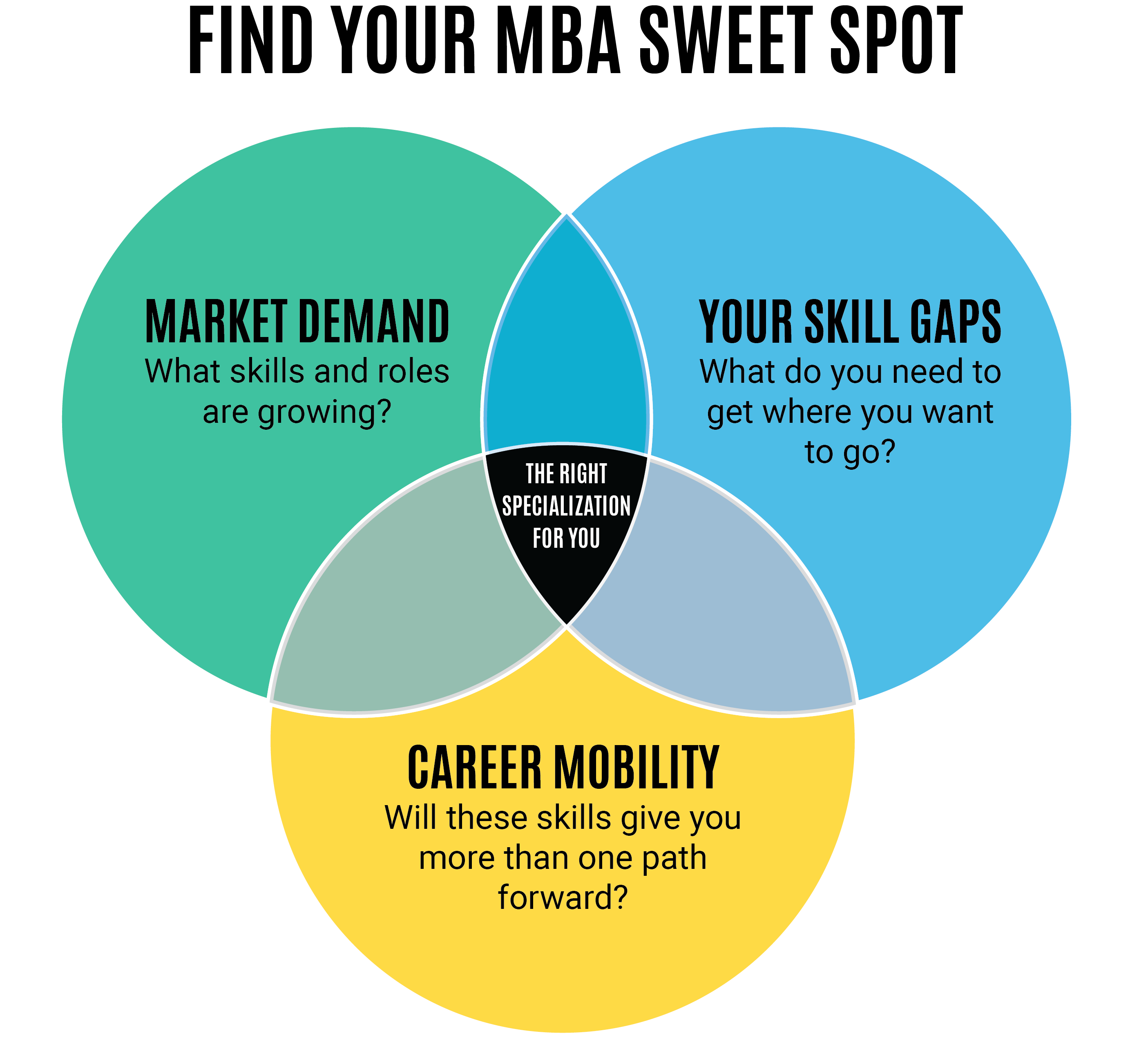
Instead of asking only which MBA specialization is best in the future, use a three-part test: market demand + your skill gaps + career optionality.
Start with demand
AI, machine learning, data science, and business analytics may be attracting attention, but don’t assume the specialization with the newest name is automatically the safest long-term choice. GMAC’s 2026 Prospective Students Survey2 found that AI has become a common curricular expectation across most graduate business degree types, alongside areas such as strategy and business analytics.
That means offering AI coursework is becoming less of a differentiator. Dig deeper. Will you learn to evaluate AI-generated insights? Apply data to strategic decisions? Understand how technology affects finance, operations, supply chain management, customers, and people?
Consider your skill gaps
Next, return to your personal skill gap. If you already have deep technical expertise, another highly technical specialization may add less value than finance, strategy, leadership, or another area that broadens your perspective.
Give your career room to move
Your next job matters, but so does the job after that. A useful specialization should deepen your expertise without boxing you into one narrow career path.
MBA must-haves: What are the key factors to consider when choosing an MBA program?
Make the program prove it.
Accreditation, rankings, specializations, and format can help you build a shortlist. Then look for proof of what the experience actually delivers:
- Career outcomes: Where do graduates go?
- Employer connections: Are there industry partnerships and real-world projects?
- Learning experience: Will you have meaningful access to faculty and applied learning?
- Alumni network: How active and useful is the network to graduates?
- Career support: What help will you receive as a working professional?
Look at the big picture
Tuition matters, but it doesn’t capture the whole value of an MBA. As you compare programs, consider:
- Time: How long will the program take, and can you set a pace that works for you?
- Income: Can you keep working and earning while you’re enrolled?
- Employer support: Does your company offer tuition assistance or reimbursement?
- Career value: Does the degree have value in the roles and industries you’re targeting?
- Outcomes: Do the program’s graduates achieve career pivots, promotions, or salary increases?
The goal isn’t to find the least expensive MBA. It’s to understand what you’re investing — and what you could get back.
GMAC’s 2026 research2 suggests prospective students are increasingly focused on the skills and return they’ll get from graduate business education — not only on using an MBA as a career reset.
So, what’s the right MBA program for you? That depends on you.
There’s no universal “best” MBA. The right one fits your goals, fills the gaps in your skill set, and gives you room to grow beyond your next role.
When making your decision, know what you need your MBA to do. Then make every program you’re considering prove it can deliver.
Think the Iowa MBA might fit the bill?
Related articles


Still have questions?
Q: Can I customize an MBA around my career goals?
A: Yes. Look for a program that lets you build expertise where it matters most to your career. The Iowa MBA offers specialized coursework and concentrations in areas such as business analytics, finance, and leadership so you can shape your experience around the skills you want to develop.
Q: Can I earn an MBA without putting my career on hold?
A: Yes. MBA programs are available in a variety of formats designed to fit different schedules and goals. Depending on the program, options may include online, in-person, or a combination of both, as well as opportunities to add experiences like global learning along the way.
Q: How can I build a professional network in an online MBA?
A: An online format doesn’t have to mean learning alone. Online MBA students build relationships through live classes, group projects, and optional in-person experiences.
MBA networking opportunities can also connect you with professionals beyond the classroom. After graduation, you can stay involved through Tippie’s alumni network, including events, professional networking, and other ways to connect with fellow Hawkeyes.
Sources
- “Corporate Recruiters Survey – 2026 Summary Report.” Graduate Management Admissions Council, 2026.
- Walker, Andrew et al. “Prospective Student Survey – 2026 Summary Report.” Graduate Management Council. 2026.